How to Identify Good Saffron: Expert Guide

Saffron is one of the most valuable spices in the world, which is why low-quality, old, or adulterated saffron can sometimes be found on the market. Knowing how to identify high-quality saffron can help you choose a product with better aroma, color, flavor, and purity.
In this guide, we explain the most practical ways to distinguish good saffron from poor-quality saffron at home.
What Does High-Quality Saffron Look Like?
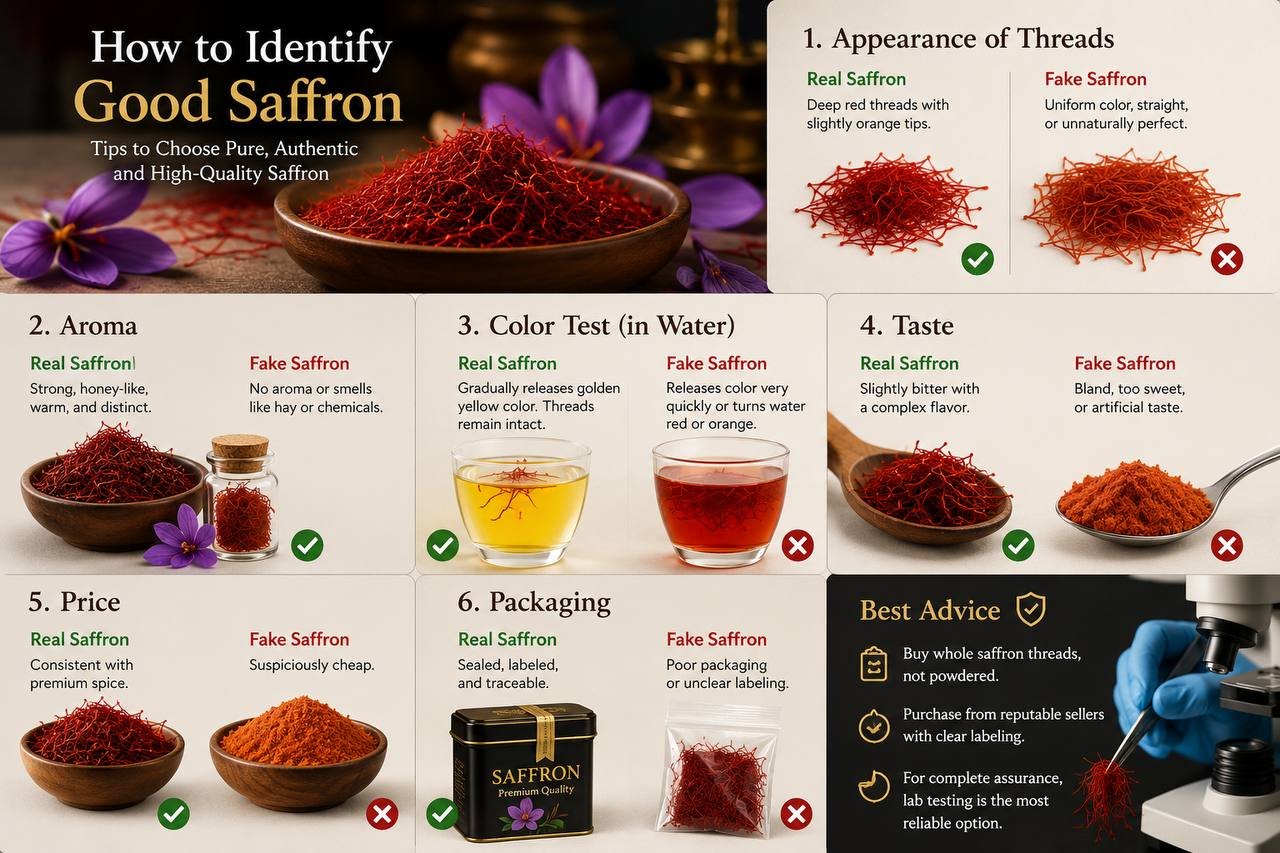
Good-quality saffron usually consists of whole, clean red stigmas with a strong natural aroma. The threads should have a deep red color rather than looking excessively yellow or pale.
The most important characteristics include:
- Strong and natural aroma
- Deep red color
- Dry and clean threads
- Natural, slightly bitter taste
- No artificial coloring
- Whole and relatively uniform threads
The color and appearance can vary depending on the saffron variety and processing method, so appearance alone cannot guarantee authenticity.
1. Check the Color of the Saffron
One of the easiest ways to examine saffron is to look closely at its threads.
High-quality saffron is generally deep red, while very pale, unusually bright, or inconsistent coloring may indicate poor quality or possible adulteration.
However, color alone is not a reliable test of authenticity because some adulterated products may be artificially colored.
2. Smell the Saffron
Authentic saffron has a distinctive, warm, earthy, and slightly sweet aroma.
If saffron has little smell, smells strongly chemical, or has an unusual artificial fragrance, it may be old, low-quality, or adulterated.
Fresh saffron should have a noticeable aroma even before it is added to food.
3. Taste a Small Amount
Real saffron generally has a slightly bitter, earthy, and distinctive taste. It should not taste strongly sweet.
If the saffron tastes unusually sweet or has a strong chemical flavor, further testing may be necessary.
Avoid consuming large amounts simply for testing purposes.
4. The Water Test
A popular home method is placing a few saffron threads in warm water.
High-quality saffron generally releases its color gradually, producing a yellow-to-golden color while the threads remain relatively intact.
If the color spreads extremely quickly and the threads lose their color immediately, this may indicate added coloring.
However, this test is not a scientifically reliable authentication method. Some genuine saffron can also release color relatively quickly depending on its processing and storage.
5. Look at the Shape of the Threads
Authentic saffron threads are the dried stigmas of the saffron flower and usually have a distinctive trumpet-like or slightly wider end.
If the product contains many pieces that look like thin grass, fibers, or completely uniform strands, it may be worth checking its authenticity more carefully.
Powdered saffron is especially difficult to evaluate visually because adulterants are much easier to mix into it.
6. Avoid Extremely Cheap Saffron
Saffron is a labor-intensive spice, and producing genuine saffron requires a large number of flowers.
For this reason, extremely cheap saffron should be treated with caution.
A very low price does not automatically mean that a product is fake, but it can be a warning sign of low quality, dilution, or adulteration.
7. Buy From a Trusted Source
One of the best ways to reduce the risk of purchasing poor-quality saffron is to buy from a reputable seller.
Look for products that provide information such as:
- Country of origin
- Harvest or production information
- Packaging date
- Batch or lot number
- Quality certification when applicable
- Proper sealed packaging
Laboratory testing remains much more reliable than home tests when accurate authentication is important.
Good Saffron vs. Bad Saffron
| Feature | Good-Quality Saffron | Poor-Quality or Adulterated Saffron |
|---|---|---|
| Color | Deep, natural red | Very pale or suspiciously uniform |
| Aroma | Strong, natural, earthy | Weak or chemical |
| Taste | Slightly bitter and distinctive | Unusually sweet or chemical |
| Threads | Natural, dried stigmas | Excessive foreign material |
| Color release | Gradual in water | May release color unusually fast |
| Price | Consistent with premium spice | Suspiciously cheap |
| Packaging | Sealed and traceable | Poor or unclear labeling |
Why Is Saffron Sometimes Adulterated?
Because saffron is expensive and produced in relatively small quantities, it can be attractive to fraudsters. Adulteration may involve adding cheaper plant materials, artificial colors, or other substances to increase weight or improve appearance.
For this reason, buying whole saffron threads from a reputable supplier is generally preferable to purchasing unidentified powdered saffron.
For more information on laboratory quality assessment, see ISO’s explanation of saffron quality testing.
Can Home Tests Prove That Saffron Is Real?
No single home test can reliably prove that saffron is authentic.
Methods such as smelling, tasting, examining the threads, or placing saffron in water can provide useful clues, but they are not definitive. Laboratory analysis is the most reliable way to confirm saffron authenticity and quality.
Frequently Asked Questions
How can I tell if saffron is real?
Look for naturally shaped red stigmas, a distinctive aroma, a slightly bitter taste, and reliable packaging. For definitive authentication, laboratory testing is required.
Does real saffron dissolve in water?
Saffron does not simply dissolve like sugar. Its pigments gradually diffuse into the water, creating a yellow or golden color while the threads remain visible.
Why is some saffron very cheap?
Extremely low-priced saffron may be lower grade, old, diluted, or adulterated. Price alone cannot prove authenticity, but it is an important factor to consider.
Is powdered saffron easier to fake?
Yes. It is generally more difficult to visually identify adulteration in powdered saffron than in whole threads.
Final Thoughts
Knowing how to identify good saffron can help you avoid low-quality or adulterated products. Pay attention to the saffron’s aroma, color, thread shape, taste, packaging, and price, but remember that home tests cannot guarantee authenticity.
For the highest confidence, choose whole saffron from a trusted supplier with clear labeling and traceability. When purity and quality are especially important, laboratory testing is the most dependable method.
