How to Identify Good Saffron: Expert Guide

How to Identify Good Saffron: 7 Practical Tips Before You Buy
Saffron is one of the most valuable spices in the world — which is exactly why low-quality, old, or adulterated saffron sometimes shows up on the market. Knowing how to identify good saffron can help you choose a product with better aroma, color, flavor, and purity, rather than paying premium prices for a diluted product.
In this guide, we cover the most practical ways to tell good saffron from poor-quality saffron at home — and where those home tests fall short.
What Does High-Quality Saffron Look Like?
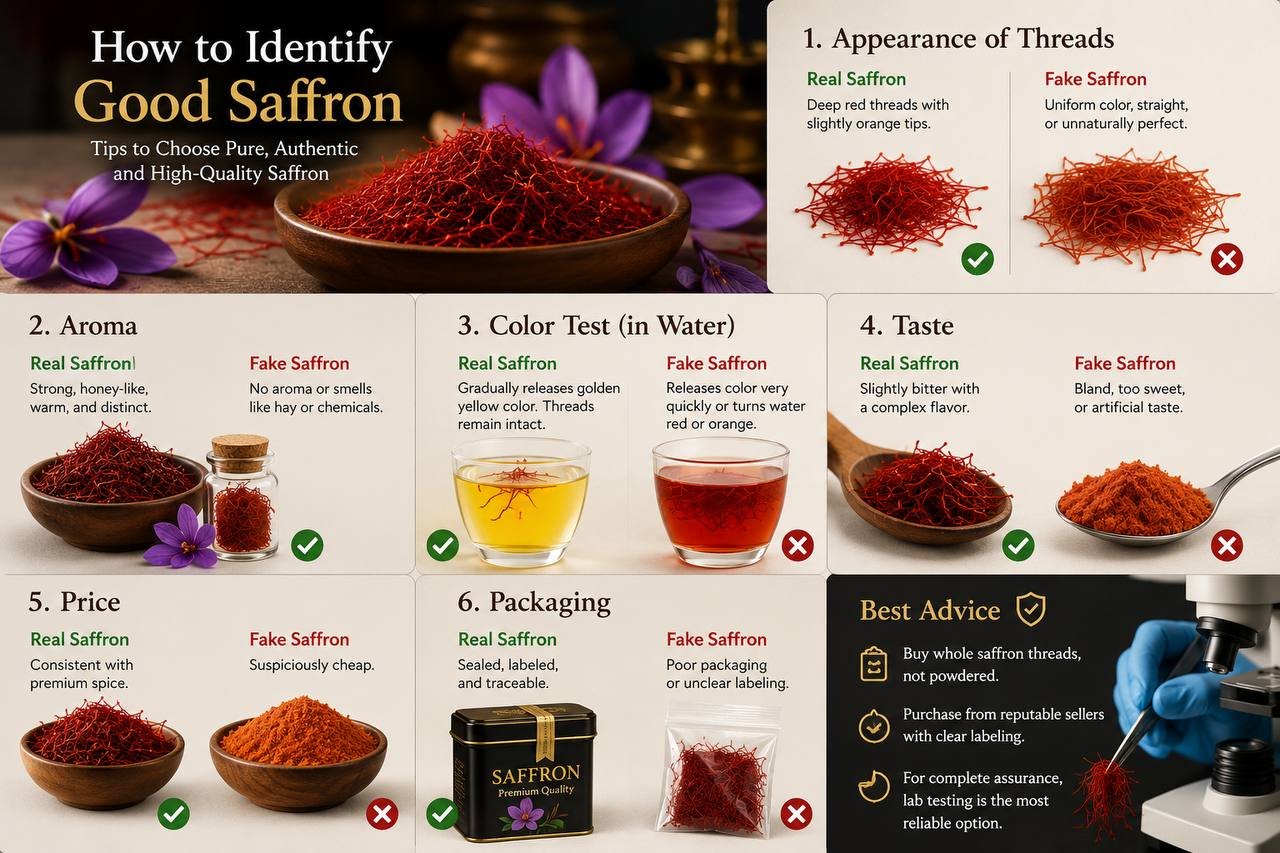
If you’re trying to figure out how to identify good saffron, start here: good-quality saffron usually consists of whole, clean red stigmas with a strong natural aroma. The threads should have a deep red color rather than looking excessively yellow or pale.
The key characteristics to look for:
- Strong, natural aroma
- Deep red color
- Dry, clean threads
- A natural, slightly bitter taste
- No artificial coloring
- Whole, relatively uniform threads
Keep in mind that color and appearance can vary by saffron variety and processing method, so looks alone can’t guarantee authenticity.
1. How to Identify Good Saffron by Color
The easiest way to start examining saffron is a close look at the threads themselves.
High-quality saffron is generally a deep red. Very pale, unusually bright, or inconsistent coloring can be a sign of poor quality or possible adulteration — though color alone isn’t a reliable test, since some adulterated products are artificially colored to compensate.
2. Smell It
Authentic saffron has a distinctive, warm, earthy, and slightly sweet aroma. If it has little smell, smells strongly chemical, or has an unusual artificial fragrance, it may be old, low-grade, or adulterated. Fresh saffron should be noticeably aromatic even before it touches food.
3. Taste a Small Amount
Real saffron has a slightly bitter, earthy, distinctive taste — it should never taste strongly sweet. If it tastes unusually sweet or has a chemical edge, that’s worth investigating further. Avoid consuming large amounts purely for testing purposes.
4. Try the Water Test
A popular home method: drop a few threads into warm water. High-quality saffron typically releases its color gradually, producing a yellow-to-golden hue while the threads stay relatively intact.
If the color spreads instantly and the threads lose their color right away, that can indicate added dye. That said, this test isn’t scientifically conclusive — some genuine saffron releases color quickly too, depending on processing and storage.
5. Look at the Shape of the Threads
Authentic saffron threads are the dried stigmas of the flower and typically have a distinctive trumpet-like, slightly wider end. If a product is full of thin, grass-like fibers or oddly uniform strands, it’s worth checking authenticity more carefully. Powdered saffron is especially hard to evaluate visually, since it’s much easier to mix in adulterants.
6. Be Wary of Extremely Cheap Saffron
Saffron is labor-intensive — producing it requires a large number of hand-picked flowers — so extremely cheap saffron deserves a closer look. A low price doesn’t automatically mean fake, but it’s a common warning sign of dilution or adulteration.
7. How to Identify Good Saffron: Buy From a Trusted Source
One of the best ways to lower your risk is buying from a reputable seller. Look for products that clearly state:
- Country of origin
- Harvest or production information
- Packaging date
- Batch or lot number
- Quality certification, where applicable
- Proper sealed packaging
If you’d rather skip the guesswork entirely, our pure saffron collection is sourced and packaged with full traceability. For serious authentication, laboratory testing remains far more reliable than any home test — the International Organization for Standardization outlines how ISO 3632 lab testing works to grade saffron and detect fraud internationally.
Good Saffron vs. Bad Saffron: A Quick Comparison
This table sums up everything you need to know about how to identify good saffron at a glance:
| Feature | Good-Quality Saffron | Poor-Quality or Adulterated Saffron |
|---|---|---|
| Color | Deep, natural red | Very pale or suspiciously uniform |
| Aroma | Strong, natural, earthy | Weak or chemical |
| Taste | Slightly bitter and distinctive | Unusually sweet or chemical |
| Threads | Natural, dried stigmas | Excessive foreign material |
| Color release | Gradual in water | Unusually fast |
| Price | Consistent with a premium spice | Suspiciously cheap |
| Packaging | Sealed and traceable | Poor or unclear labeling |
Why Is Saffron Sometimes Adulterated?
Because saffron is expensive and produced in relatively small quantities, it’s an attractive target for fraud. Adulteration can involve mixing in cheaper plant material, artificial dyes, or other substances to boost weight or improve appearance. That’s exactly why buying whole saffron threads from a reputable supplier generally beats picking up unidentified powdered saffron.
Can Home Tests Prove Saffron Is Real?
No single home test can definitively prove saffron is authentic. Smelling, tasting, examining the threads, or dropping saffron in water can all offer useful clues — but none of them are conclusive on their own. Laboratory analysis remains the most reliable way to confirm authenticity and quality.
Frequently Asked Questions
How can I tell if saffron is real?
Look for naturally shaped red stigmas, a distinctive aroma, a slightly bitter taste, and reliable packaging. For definitive authentication, lab testing is required.
Does real saffron dissolve in water?
Not exactly — saffron doesn’t dissolve like sugar. Its pigments gradually diffuse into the water, creating a yellow or golden color while the threads stay visible.
Why is some saffron very cheap?
Extremely low-priced saffron may be lower grade, old, diluted, or adulterated. Price alone can’t prove authenticity, but it’s an important signal to weigh.
Is powdered saffron easier to fake?
Yes — it’s generally much harder to visually spot adulteration in powdered saffron than in whole threads.
Final Thoughts on How to Identify Good Saffron
Knowing how to identify good saffron can save you from low-quality or adulterated products. Pay attention to aroma, color, thread shape, taste, packaging, and price — but remember that home tests can’t guarantee authenticity on their own.
For the highest confidence, choose whole saffron from a trusted supplier with clear labeling and traceability. When purity and quality really matter, laboratory testing is still the most dependable method.
