Real vs Fake Saffron: 7 Easy Tests


How to Tell If Saffron Is Real or Fake: 7 Easy Tests
Real vs Fake Saffron can be difficult to identify, especially when buying saffron for the first time. Fortunately, a few simple tests can help you recognize authentic saffron and avoid low-quality or counterfeit products.
How to Tell If Saffron Is Real or Fake at Home
No single home test can guarantee that saffron is authentic. Professional laboratory testing is more reliable.
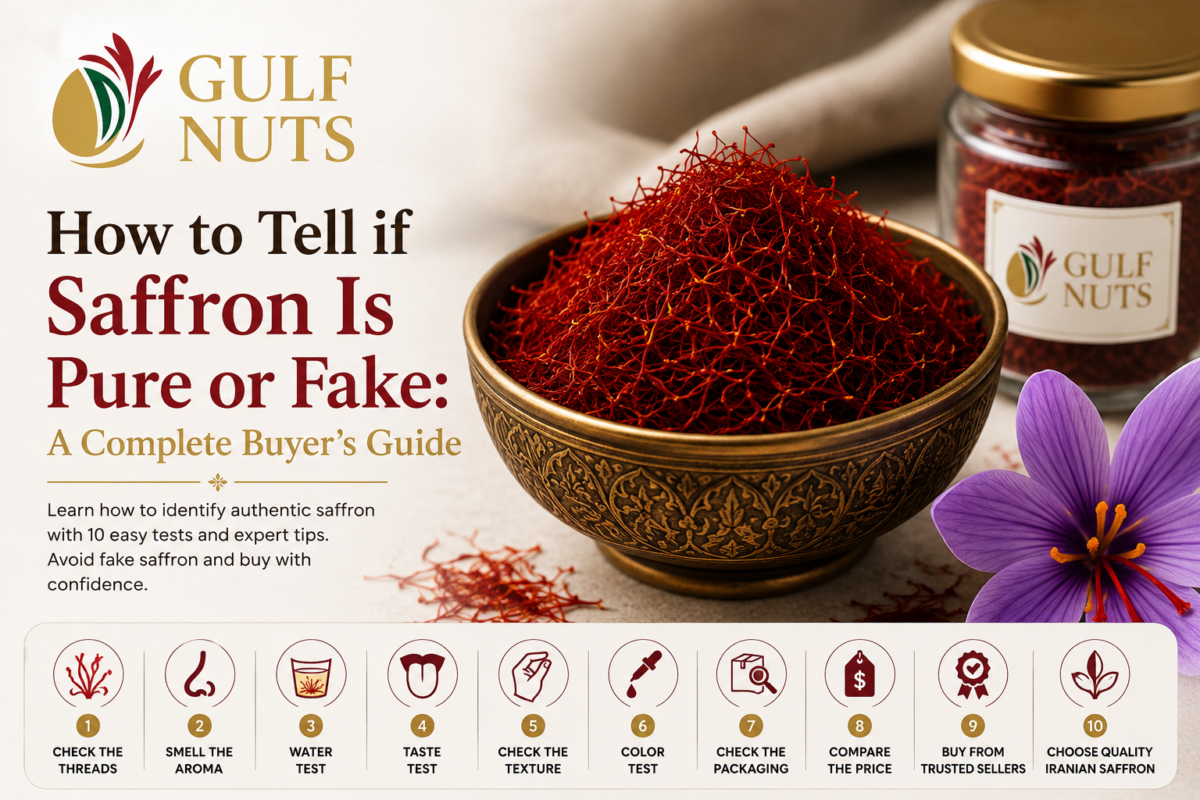
Still, genuine saffron usually has several recognizable characteristics. Look at the threads, smell the saffron, taste a tiny amount, and observe how it behaves in warm water.
Let’s go through these checks one by one.
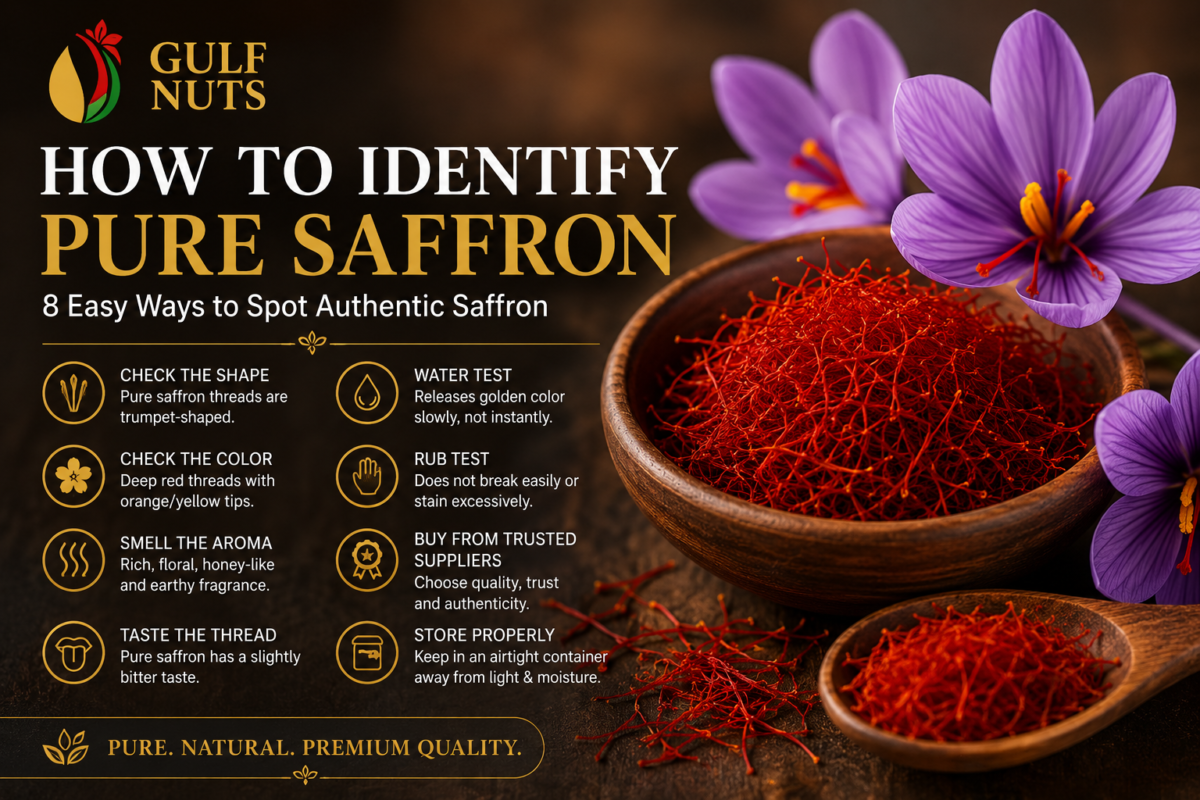
1. Check the Saffron Threads
Start with the easiest test: look closely at the threads.
Real saffron comes from the dried stigmas of the Crocus sativus flower. The threads are not normally identical in shape.
Genuine saffron threads commonly have:
- A deep red to crimson appearance
- A slightly wider or trumpet-like end
- Thin, irregular natural shapes
- Little or no unnecessary yellow plant material
Be cautious if every piece looks perfectly uniform or the product contains unusual fibers that do not resemble saffron stigmas.
2. Test Saffron in Warm Water
The water test is one of the easiest ways to examine saffron at home.
Place a few threads in a clear glass or cup of warm water. Do not use boiling water.
Wait several minutes.
Good saffron should gradually release its pigments into the water. The liquid typically develops a golden-yellow color rather than instantly becoming an intense artificial red.
The threads may also retain much of their structure and color for some time.
Color alone cannot always identify real vs fake saffron, so you should also check the aroma and thread structure.
Does Real Saffron Turn Water Red?
Not normally in the way artificial dye does.
Saffron contains natural pigments, including crocins, which contribute to its characteristic coloring ability. When infused, good saffron generally creates a yellow to golden-orange infusion.
If a few threads immediately create an unnaturally strong red cloud, inspect the product more carefully.
3. Smell the Saffron
Aroma is another useful clue when learning how to tell if saffron is real or fake.
Real saffron has a powerful and complex fragrance. People describe it in different ways, but it may seem floral, earthy, hay-like, or slightly sweet.
It should not simply smell like perfume or artificial fragrance.
If the saffron has almost no aroma, poor storage or age may also be responsible. That does not automatically prove that it is fake.
4. Taste a Tiny Saffron Thread
Saffron may smell pleasantly aromatic, but its taste is not simply sweet.
Place a very small thread on your tongue.
Authentic saffron generally has a distinctive, somewhat bitter taste. A product that tastes noticeably sugary may deserve closer inspection.
You only need a tiny amount for this test.
5. Rub a Thread Between Your Fingers
You can also examine what happens when a slightly damp saffron thread is rubbed between your fingers.
Natural saffron can release color, especially when moisture is present. However, suspicious material may release an unusually strong surface dye very quickly.
Again, this test alone is not proof.
Use it together with the thread, aroma, taste, and infusion checks.
Aroma and taste provide additional clues when comparing real vs fake saffron.
6. Compare the Price
Saffron is expensive for a reason.
The spice comes from individual flower stigmas, and harvesting and processing require substantial manual work. Therefore, an unusually cheap offer should make you cautious.
A low price does not automatically mean a product is fake. Likewise, a high price does not guarantee authenticity.
Instead, consider price together with:
- Seller reputation
- Country or region of origin
- Packaging
- Product information
- Quality certification or testing when available
7. Check the Packaging Before Buying
Good packaging matters because saffron is sensitive to environmental conditions.
Before buying, check whether the package clearly provides useful information such as net weight, origin, seller or producer details, and relevant dates or batch information.
Choose saffron stored in a well-sealed package.
After opening it, keep the spice protected from excessive light, heat, air, and moisture.
The water test is a simple way to compare real vs fake saffron at home.
Real vs Fake Saffron: Quick Comparison
| Feature | Genuine Saffron | Suspicious Saffron |
|---|---|---|
| Threads | Irregular natural stigmas | May look unusually uniform |
| Infusion | Gradual golden-yellow color | May release intense dye rapidly |
| Aroma | Strong and complex | Weak or artificial |
| Taste | Distinctive and slightly bitter | May taste unusually sweet |
| Price | Generally expensive | Extremely low price can be a warning |
| Packaging | Clear product information | Details may be limited or unclear |
Remember that these are warning signs, not laboratory confirmation.
What Is the Most Reliable Saffron Test?
Home tests are useful for basic screening, but they have limitations.
The most reliable assessment comes from proper laboratory analysis. International standards such as ISO 3632 are used for testing important characteristics of saffron.
This is particularly important for businesses, importers, wholesalers, and anyone purchasing saffron in large quantities.
Saffron Tea Benefits: What Happens Daily?
Can Fake Saffron Pass a Water Test?
Potentially, yes.
That is why you should not judge saffron using only one viral “home test.”
A sophisticated adulterated product may behave differently from an obviously dyed imitation. Even genuine saffron can vary because of its grade, age, storage conditions, and origin.
For a better assessment, combine several observations.
How to Tell If Saffron Is Real Before Buying
You obviously cannot put saffron into a glass of water before every purchase.
Instead, evaluate the seller and product.
Look for transparent information about the saffron, inspect the packaging, compare the price with realistic market prices, and avoid offers that make unsupported quality claims.
For online purchases, clear product photos and detailed specifications are especially useful.
Comparing real vs fake saffron becomes easier when you know what genuine saffron threads should look like.
How to Keep Real Saffron Fresh
Buying good saffron is only half the job. Storage affects its aroma and overall quality.
Keep saffron in a tightly closed container in a cool, dry, and dark location. Avoid placing it near steam, direct sunlight, or strong-smelling foods.
Internal link: Link this sentence to your existing How to Store Saffron Properly article:
Read our complete guide on how to store saffron properly to protect its aroma, color, and flavor.
And add another internal link:
Not sure how much you need? See our guide to how much saffron you should use.
Saffron Tea: A Golden Elixir With Powerful Health Benefits
Frequently Asked Questions About Real and Fake Saffron
What color does real saffron make in water?
Real saffron generally creates a yellow to golden-orange infusion as its natural pigments are released. The process is usually gradual rather than an instant burst of artificial-looking red dye.
Should real saffron taste sweet?
No. Although saffron’s aroma can have sweet notes, its taste is characteristically distinctive and somewhat bitter.
Does expensive saffron mean it is real?
No. Price is only one clue. An expensive product can still be poor quality, so consider the seller, packaging, origin, appearance, aroma, and available quality information.
Can I identify fake saffron just by looking at it?
Sometimes obvious imitations can be spotted visually, but appearance alone is not reliable enough. Combine several checks or rely on laboratory testing when authenticity is critical.
Is powdered saffron harder to check?
Yes. Once saffron is ground into powder, visual inspection of the original stigmas is no longer possible. Buying whole threads can make basic visual assessment easier.
Final Thoughts: How to Tell If Saffron Is Real or Fake
Learning how to tell if saffron is real or fake can help you make smarter buying decisions. Examine the threads, watch the infusion, check the aroma and taste, consider the price, and pay attention to packaging.
However, home tests should be treated as practical clues rather than scientific proof. When verified authenticity or grade is essential, laboratory testing and recognized quality standards provide much stronger evidence.
High-quality saffron should deliver the characteristic aroma, color, and flavor that make this spice so valuable.
Knowing the differences between real vs fake saffron can help you avoid low-quality products and choose saffron with greater confidence.